
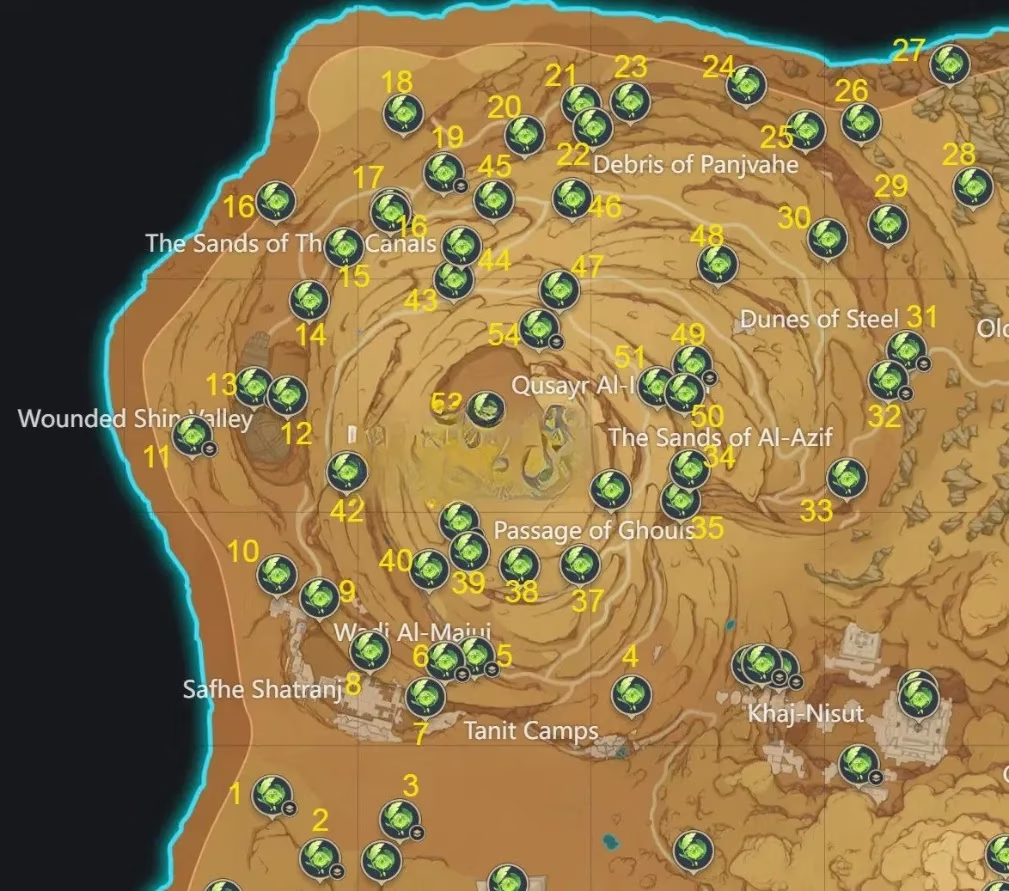
As of 2026, the vast and windswept Desert of Hadramaveth remains a formidable and captivating corner of Teyvat within Genshin Impact. This arid expanse, added to the world years prior, introduced 55 elusive Dendroculi, bringing the total available at the time to 235 and offering players a substantial new challenge for upgrading Sumeru's Statues of the Seven. While the grand narrative of Teyvat has since expanded, the meticulous exploration required to find these glowing green orbs amidst the ruins and raging sandstorms of Hadramaveth endures as a rite of passage for dedicated adventurers.
The Scattered Jewels of the Sands
The majority of these Dendroculi are not hidden in deep obscurity but are instead scattered across the sun-baked surface of the desert, perched like forgotten emeralds on ancient ruins or nestled within rock formations that stand as silent sentinels against time. Others, however, embrace the subterranean mystery that defines Sumeru, lurking within intricate cave systems and long-sealed tombs. Finding them requires more than just a keen eye; it demands resilience against the environment's fury. The ever-present sandstorms of Hadramaveth are not merely visual effects—they are environmental puzzles, often concealing pathways or creating updrafts that must be mastered to reach a Dendroculus dangling just out of reach. Navigating this terrain is like trying to read a book in a hurricane, where landmarks blur and the path forward is rewritten by the wind.
The Traveler's Trusty Tool: The Resonance Stone
For those who prefer a more guided hunt, the Dendroculus Resonance Stone is an indispensable tool. Its blueprint, a reward for achieving Sumeru Reputation Level 8, allows players to craft this navigational aid at any alchemy table. The recipe is straightforward but requires specific Sumeru flora:
| Material | Quantity Required |
|---|---|
| Nilotpala Lotus | 5 |
| Rukkhashava Mushroom | 5 |
| Crystal Chunk | 1 |
| Mora | 500 |
Once crafted and used, the stone acts as a dowsing rod for Dendro energy, pointing the player toward the general vicinity of the nearest uncollected Dendroculus. However, it does not provide exact coordinates. The orb's precise location will only appear on the minimap when the player is almost upon it, making the final approach a test of observation. This mechanic ensures that the discovery of each Dendroculus feels earned, a small treasure hunt culminating in a satisfying chime and a flash of green light.
A Legacy of Exploration
When the Desert of Hadramaveth was first unveiled, its 55 Dendroculi were a significant addition, hinting at the scale of Sumeru yet to come. The region was always planned to host 270 Dendroculi in total, meaning the remaining 35 were earmarked for future, unreleased areas. For veteran players in 2026, collecting these 55 orbs in Hadramaveth is often looked back upon as a foundational chapter in their exploration of Sumeru. The journey to find each one weaves through the heart of the desert's lore, from surface-level Oases to the deep, echoing halls of the Mausoleum. Each Dendroculus collected is not just a statistic for the statue; it is a memory pinned to the map—a moment where a treacherous climb was rewarded, or a hidden chamber, as quiet as a held breath, was finally illuminated. The hunt transforms the desert from a barren wasteland into a intricate game board, where every dune and cliff face holds potential.
Ultimately, the Dendroculi of the Desert of Hadramaveth represent more than just upgrade materials. They are invitations to engage deeply with one of Genshin Impact's most atmospheric regions. They force travelers to grapple with verticality, to decode environmental clues, and to appreciate the stark beauty of a land shaped by wind and time. Completing this collection is a testament to a player's perseverance, leaving them not only with a more powerful Statue of the Seven but with an intimate, hard-won knowledge of every hidden crevice and soaring vista in the golden sea of sand.